500 Hour Yoga Teacher Training in Rishikesh — RYT 500 eligible certification, 56-day residential TTC combining 200hr + 300hr in one Himalayan stay.
500 Hour Yoga Teacher Training in Rishikesh, India
A 500 hour yoga teacher training is the most significant investment you will make in your teaching life. It is also the credential that opens the door to teaching advanced, therapeutic, and specialist yoga — and to being taken seriously as a professional in an increasingly crowded field. At Maunvan, the 500 hour yoga teacher training in Rishikesh is a 56-day residential program that covers both the 200-hour foundation and the 300-hour advanced training in one uninterrupted Himalayan stay — earning you full RYT 500 eligible certification from a Yoga Alliance registered school.
Most students who come for a 500hr yoga teacher training are at one of two points: they have completed their 200-hour and want to go deeper without waiting another year, or they are ready to commit to the full journey from the beginning and want to complete it all in one serious stretch. Both are welcome here. What does not change either way is the format — small batches of maximum 12 students, Himalayan ashram setting, classical teachers, and an all-inclusive structure so you arrive and focus entirely on learning.
This 500 hour yoga teacher training course in Rishikesh is not built for speed. It is built for depth — for teachers who want to understand yoga well enough to guide others safely and honestly into advanced practice. If that is what you are looking for, you are in the right place.
What is the 500 Hour Yoga Teacher Training in Rishikesh?
The 500 hour yoga teacher training is the advanced professional credential recognised by Yoga Alliance worldwide. It is not simply more hours added to a 200-hour program — it is a fundamentally deeper level of study. Where the 200-hour covers the foundations of asana, anatomy, and basic teaching skills, the 500-hour goes into therapeutic applications, advanced sequencing, applied physiology, classical philosophy from primary texts, and the teaching competence needed to guide complex students safely. Completing a 500 hour yoga TTC in India — in Rishikesh, where these practices are still taught in their classical lineages — gives the training a living context that no Western studio program can provide.
At Maunvan, the 500 hour yoga TTC in Rishikesh runs in two consecutive phases within the same 56-day residential stay. Phase 1 — the 200-hour foundation — covers classical Hatha yoga, foundational anatomy, pranayama and meditation, the Yoga Sutras of Patanjali, and core teaching methodology. Students already holding a 200-hour certificate from a Yoga Alliance registered school can enter Phase 2 directly, completing the 300-hour advanced training in four weeks and qualifying for RYT 500 registration alongside their existing certificate. This makes the 500 hour yoga teacher training course in Rishikesh accessible whether you are starting fresh or building on prior study.
Phase 2 moves into territory that genuinely changes how you teach. Advanced asana work focuses on therapeutic adjustments, intelligent sequencing, and reading individual students in real time. Anatomy advances to applied physiology — nervous system regulation, fascial anatomy, breath science. Philosophy deepens into the Bhagavad Gita, Samkhya, and the living Himalayan transmission of yoga. Teaching practicum puts you in front of real students with detailed, specific feedback from senior teachers every step of the way.
Who is this 500 Hour Yoga Teacher Training for?
No prior certificate needed — the combined program starts from the 200-hour foundation. A sincere personal practice and genuine intention to teach is all that is required.
Existing RYT-200 holders — enter Phase 2 directly, complete the 300-hour advanced training in four weeks, and register as RYT-500 with your existing certificate from any Yoga Alliance school.
Dedicated practitioners who want to take their personal practice to a teaching level — or who already practise deeply and want formal training that matches that depth.
Anyone wanting to complete their 500 RYT training in India in one immersive stay — rather than returning across two separate trips to complete the 200-hour and 300-hour programs separately.
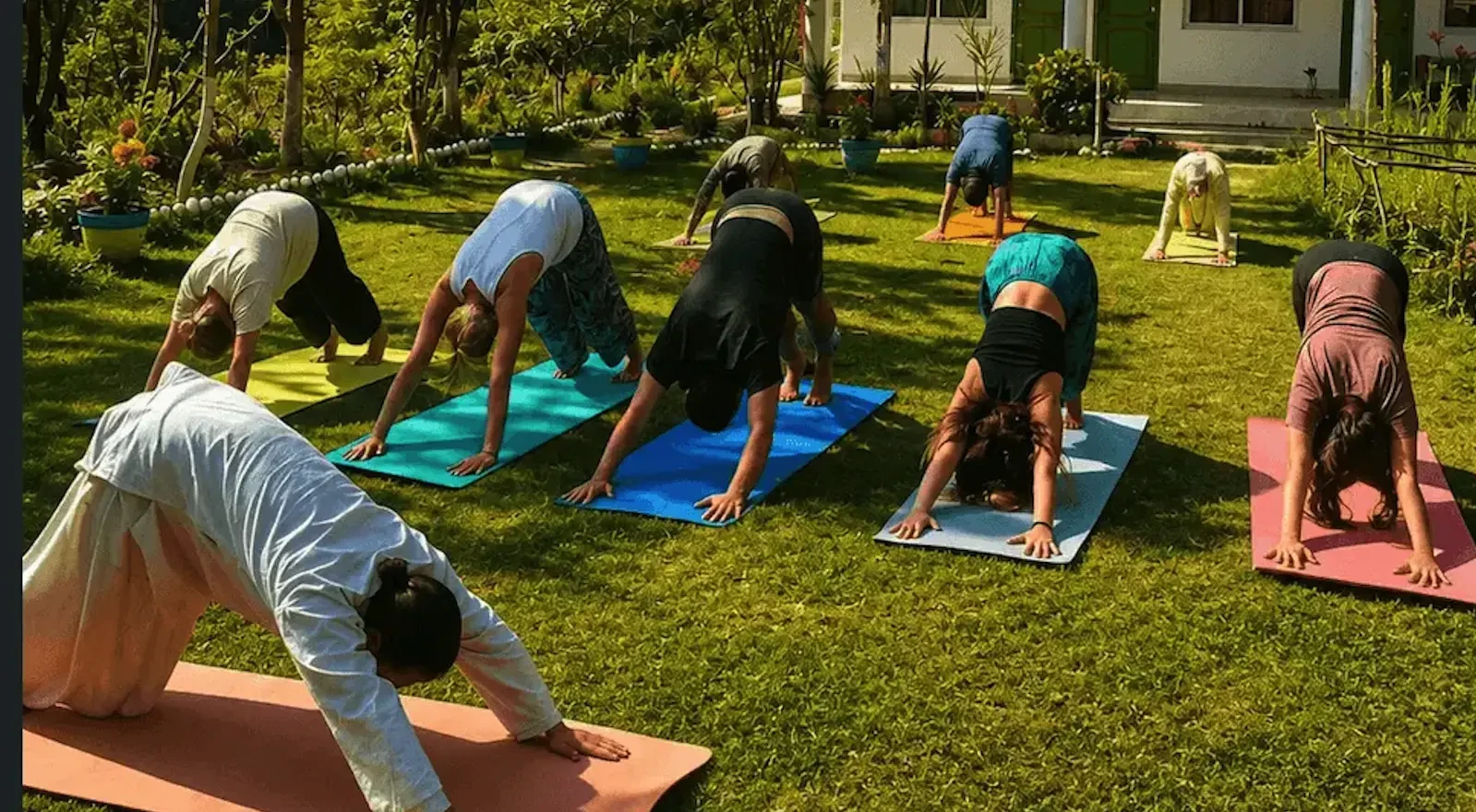
Maunvan's ashram sits on a forested ridge above the Ganga valley — genuinely quiet, clean-aired, and away from the noise of commercial Rishikesh. The setting is not incidental to the training. Eight weeks of intensive study is made possible by the environment you wake up in each day: sunrise practice above the valley, focused study through the day, and real Himalayan quiet at night. This is what a 500 hour yoga teacher training in Rishikesh India is designed to be — not a course you attend, but an immersion you go through.
All fees are all-inclusive — accommodation, 3 sattvic meals daily, all training sessions, study materials, and certification. No hidden extras.
Accommodation
Fee (USD)
Batch Dates
Single Room
$2,400
Coming Soon
Shared Room
$2,100
Coming Soon
Batch dates for 2026 / 2027 will be announced shortly. Contact us on WhatsApp to register your interest and be notified first.
What Does the 500 Hour Curriculum Cover?
The curriculum is structured across six core modules across both phases. Each module deepens progressively — foundational in Phase 1 (200hr), advanced application in Phase 2 (300hr).
Kumbhaka, Shatkarmas, subtle body (nadis, chakras)
Philosophy
Yoga Sutras of Patanjali — intro
Bhagavad Gita, Samkhya, Hatha yoga texts
Teaching
Cueing, sequencing, hands-on assists
Diverse populations, injuries, specialty programs
Specialty Styles
Restorative basics
Yin, Yoga Nidra, therapeutic applications
Six Core Modules
1
Asana Mastery
Classical Hatha, Ashtanga primary and intermediate series, Yin Yoga, and therapeutic modifications. From foundational alignment in Phase 1 to advanced sequencing, backbending, arm balances, inversions, and injury-safe adjustments in Phase 2. Practised twice daily throughout the 56-day program.
2
Pranayama & Kriyas
Systematic study of classical pranayama techniques — Nadi Shodhana, Kapalabhati, Bhastrika, Ujjayi, Bhramari, Kumbhaka. Phase 2 introduces the Shatkarmas (yogic cleansing practices) and the subtle anatomy of prana, the nadis, and the chakra system as described in the classical Hatha yoga texts.
3
Advanced Anatomy & Physiology
Phase 1 covers structural anatomy — bones, joints, muscles, and their role in the major asana categories. Phase 2 advances to applied physiology — nervous system regulation, fascial anatomy, breath mechanics, the science behind pranayama's effects, stress physiology, and therapeutic contraindications. Essential for safe advanced teaching.
4
Philosophy & Ethics
Study of the Yoga Sutras of Patanjali in depth across both phases. Phase 2 adds the Bhagavad Gita, Samkhya philosophy, key Hatha yoga texts, and the ethics of the teacher-student relationship. Not academic study — these texts are read as living guides to practice, with daily application in asana, pranayama, and meditation.
5
Advanced Teaching Methodology
Phase 1 introduces teaching fundamentals — cueing, sequencing, hands-on assists, class management. Phase 2 develops advanced teaching skills: teaching to diverse populations, working with injuries and limitations, designing specialty programs, mentoring students, and the pedagogical principles that distinguish an effective teacher from a knowledgeable practitioner.
6
Specialty Styles & Therapeutics
Phase 2 specifically trains advanced teaching in Yin Yoga, Restorative Yoga, Yoga Nidra, and therapeutic applications for common conditions including back pain, anxiety, and hormonal imbalance. Students practise teaching these specialties in supervised practicums with real-time feedback from Maunvan's senior teachers.
Daily Schedule
The daily structure of the 500 Hour TTC at Maunvan is intensive by design — this is an immersive residential training, not a weekend workshop. The day follows the classical yogic understanding of time: early rising to catch the Brahma muhurta (the powerful hour before sunrise), a full day of practice and study, and early rest to support the body's recovery. The schedule remains broadly consistent across both phases, with the content deepening week by week.
Daily Timetable — 500 Hour TTC
05:30 AM
Wake Up
Rise before sunrise. Wash, dress, and prepare for morning practice in the Himalayan quiet.
06:00 AM
Pranayama & Meditation
75 minutes of guided pranayama — the techniques studied in the curriculum practiced daily. Followed by 20–30 minutes of silent meditation. The practice deepens each week as technique builds.
07:30 AM
Asana Practice
90 minutes of Hatha or Ashtanga yoga. Phase 1 focuses on foundational alignment and classical sequences. Phase 2 works into advanced postures, arm balances, deep backbends, and inversions — always with safety and anatomical intelligence at the centre.
09:15 AM
Breakfast
Sattvic vegetarian meal. Prepared fresh each morning to support the body's recovery and the afternoon's study sessions.
10:30 AM
Anatomy / Philosophy / Teaching Methodology
Morning study session — the content rotates through the three theoretical pillars of the training. Teaching methodology classes include live teaching practice, peer observation, and teacher feedback.
12:30 PM
Second Study Session
Deeper dive into the morning's subject, or an alternating module. Philosophy is studied from the primary texts, not slides. Anatomy workshops use models and hands-on body-mapping.
01:30 PM
Lunch & Rest
Main sattvic meal of the day. Free time follows — rest, independent study, journaling, or quiet walks through the ashram's forest grounds.
03:30 PM
Teaching Practicum / Workshop
Supervised teaching sessions where students practise teaching their peers — starting with short sequences in Phase 1 and building to full-class teaching with complex populations in Phase 2. Real-time feedback from senior teachers.
05:00 PM
Afternoon Practice
Yin Yoga, Restorative Yoga, or Yoga Nidra — the passive counterpart to the morning's active practice. This is also where specialty styles are taught in Phase 2.
07:00 PM
Dinner
Light sattvic evening meal to support restful sleep and early rising.
08:00 PM
Satsang & Self-Study
Evening mantra chanting, group discussion, or individual study. Lights out by 10:00 PM to honour the early morning schedule and support full recovery.
The schedule includes one rest day per week. Advanced students in Phase 2 have access to additional early-morning self-practice time before the group session begins.
What is Included in the 500 Hour TTC Fee?
The all-inclusive fee at Maunvan means one payment covers everything required to complete the training. There are no per-session charges, no additional study material fees, and no hidden costs that appear after you arrive.
✓Inclusions
🛏
56 Nights Accommodation
Shared or private room at Maunvan ashram
🥗
All Meals — 56 Days
Three sattvic vegetarian meals daily throughout the training
🧘
All Training Sessions
Every asana class, pranayama session, and practicum
📚
Study Materials
Course manual, anatomy workbook, philosophy texts
👨🏫
Teacher Support
Personal guidance and practicum feedback throughout
📜
RYT-500 Eligible Certificate
Yoga Alliance recognised certification on completion
✕Exclusions
✈️
Travel to Rishikesh
Flights, trains or buses not included
👜
Personal Expenses
Shopping, tips, phone data, personal items
🛡️
Travel Insurance
Strongly recommended — arrange separately
🌿
Ayurvedic Treatments
Optional add-on at extra cost
🎓
Yoga Alliance Registration Fee
Paid directly to Yoga Alliance to register as RYT-500
Where Do You Stay During the 500 Hour TTC?
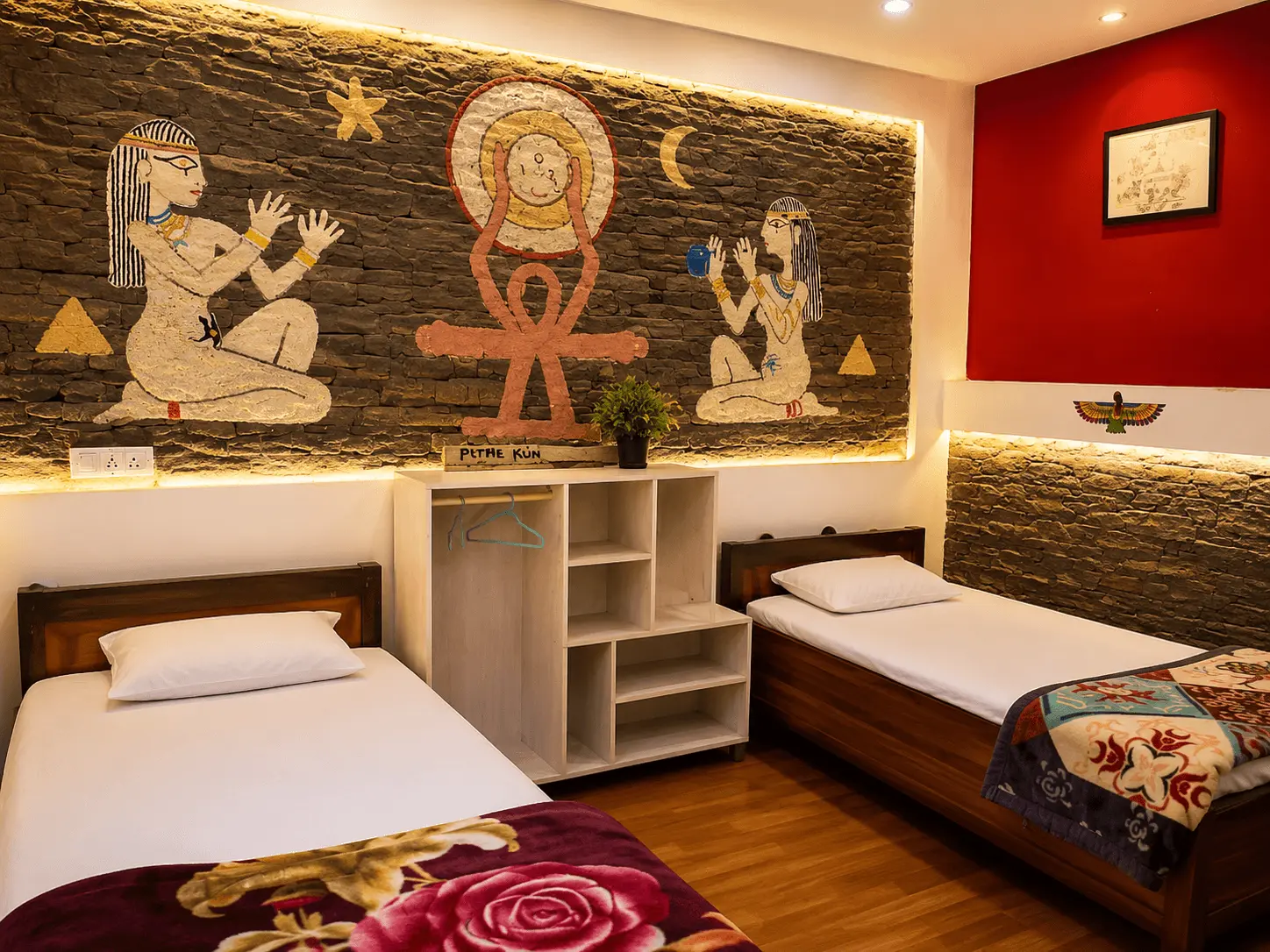
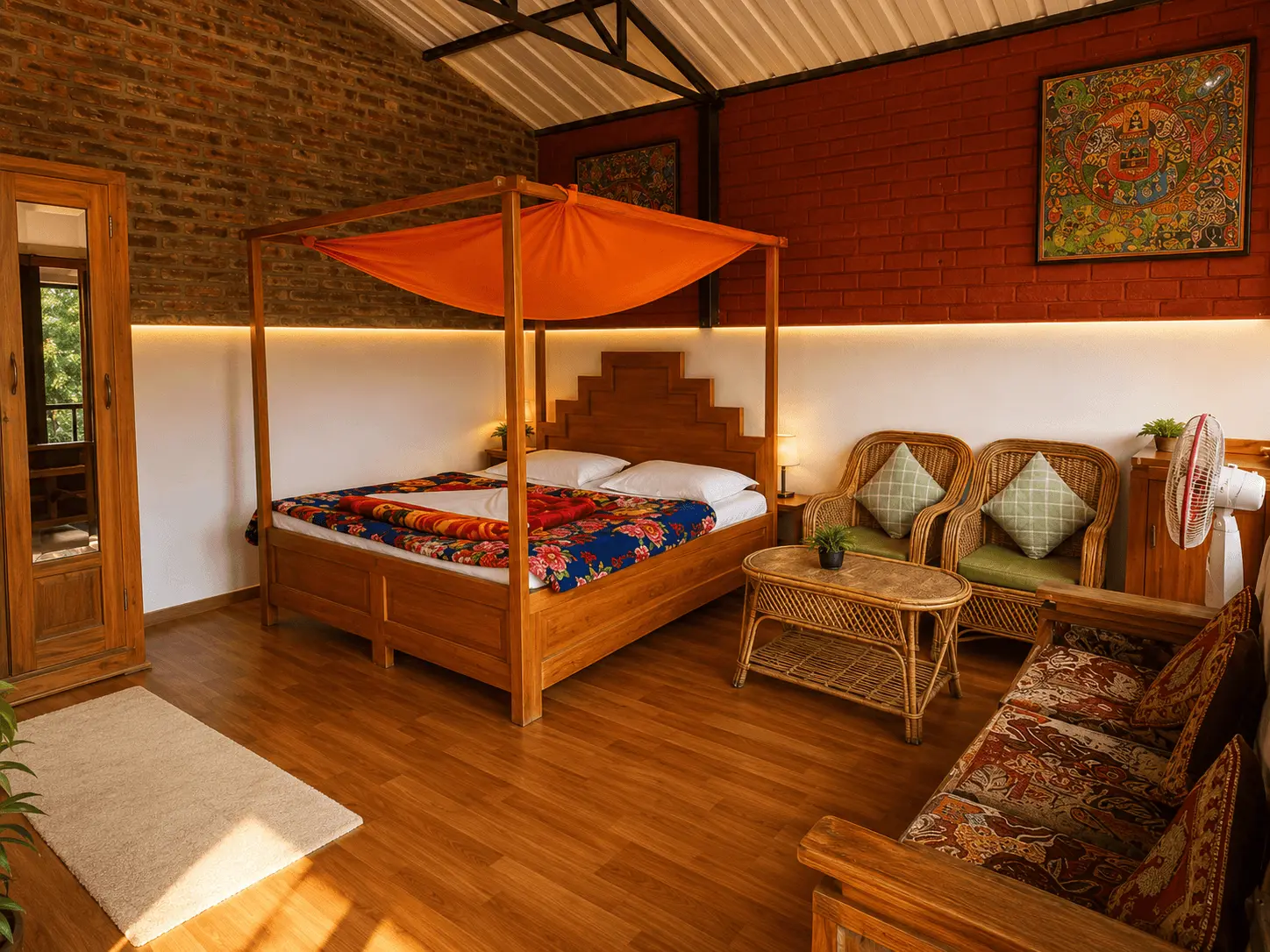
All accommodation is at Maunvan ashram on a forested ridge above the Ganga valley — a genuinely quiet setting where eight weeks of intensive study becomes possible. Your room is your base for the full 56 days of the training: simple, clean, and designed to support deep rest and recovery rather than distraction.
🛏
Private Single Room
For students who prefer their own space during the training. Simply furnished with a comfortable bed, storage, and attached or shared bathroom. For eight weeks of intensive study, privacy can significantly support the depth of your experience.
🛌
Double Sharing Room
Book with a travel companion or be matched with another participant of the same gender. The shared experience of living alongside fellow students for eight weeks often becomes one of the most valuable parts of the training — genuine community in practice.
🌿
Himalayan Forest Setting
The ashram grounds include forest paths, a meditation garden, and quiet sitting areas. The natural environment is a genuine asset during intensive training — clean air, birdsong, and actual Himalayan quiet at night support recovery in ways that no urban training environment can replicate.
🚿
Essential Facilities
Hot water, clean bathrooms, and regular housekeeping. Not a luxury hotel — but everything actually needed for eight weeks of residential training is here and maintained consistently. Yoga Alliance teacher training is demanding; the simplicity of ashram living supports the focus it requires.
All accommodation is included in the training fee for the full 56 days. No extra charges for room use or early check-in on arrival day (subject to availability).
Why Choose Maunvan ?
There are many 500 hour yoga teacher training options in Rishikesh and across India. The differences between programs matter enormously — because the depth of what you learn over 56 days depends entirely on the teachers, the group size, the setting, and how seriously the school takes the curriculum. Below are the concrete, specific reasons students choose Maunvan for their 500 yoga teacher training India experience.
Maunvan is a Yoga Alliance registered school (RYS). All graduates qualify for RYT 500 registration — the advanced international credential recognised by studios, wellness centres, and employers globally. Also see our 200 Hour TTC, 300 Hour TTC, and yoga retreats in Rishikesh.
12
Maximum 12 Students per Batch
The group is capped at 12 for every batch. This is not a target number — it is a firm limit. Small-group training at this level means your teachers know your practice deeply from the first week. Individual feedback in teaching practicums is detailed and specific, not general. This is the most important structural decision Maunvan makes, and it shapes everything else.
56D
Full 56-Day Residential Immersion
The 500 Hour TTC at Maunvan runs as a genuine immersion — all 56 days at the ashram, all meals included, full schedule every day. This is not a hybrid program or a self-paced online certification. The depth of change that eight weeks of uninterrupted residential training produces cannot be replicated in any other format.
🏔
Genuine Himalayan Location
Maunvan is not on a Rishikesh main road or in a commercial ashram district. The setting on a forested ridge above the Ganga valley is quiet, clean-aired, and genuinely natural. This matters for eight weeks of intensive study — the environment you live in shapes the quality of practice and the depth of learning.
ALL
Truly All-Inclusive Pricing
One fee. 56 nights accommodation, three meals daily for 56 days, every training session, all study materials, all practicums, and the final certification. No hidden extras discovered on arrival. The total cost of completing the training is the price listed on this page — nothing more.
🕉
Classical Tradition, Not Commercial Yoga
Maunvan's teachers bring years of training in the classical Indian yoga tradition — in the lineages taught in the Himalayas, not in international yoga studios. The 500 Hour curriculum is built on primary texts and classical methods, adapted for contemporary teaching contexts but rooted in tradition. Philosophy at Maunvan is studied seriously, not mentioned in passing.
📅
Monthly Batches All Year
The 500 Hour TTC begins on the 1st of every month throughout the year. You do not need to wait for a fixed annual cohort start date or adjust your life around a single intake. Rishikesh's climate runs from Himalayan cool in winter to monsoon lush in summer — every season offers a different but equally valuable training environment.
What is the 500 Hour Yoga Teacher Training at Maunvan, Rishikesh?
A 56-day residential RYT 500 program in Rishikesh, India combining 200-hour foundation and 300-hour advanced training in one Himalayan stay. All-inclusive fee. Maximum 12 students per batch. Also available as a standalone 200hr TTC or 300hr advanced TTC.
Frequently Asked Questions
What is the difference between 200hr and 500hr yoga teacher training? +
The 200-hour training is the entry-level yoga teaching qualification — it gives you the foundation to teach general yoga classes as an RYT-200. The 500 hour yoga teacher training is a different level of education entirely. It builds on the 200-hour with advanced asana, therapeutic yoga, applied anatomy and physiology, advanced pranayama, deeper yoga philosophy, and the kind of teaching methodology that lets you work with diverse student needs rather than just guiding a general class. The 500 hour yoga teacher training course at Maunvan can be completed as a combined 56-day program (200hr + 300hr in one residential stay) or, if you already hold a 200-hour certificate, as a standalone 300-hour advanced training — both paths lead to RYT 500 registration eligibility.
Can I do the 500 Hour TTC at Maunvan if I have a 200hr from another school? +
Yes. If you already hold a valid 200-hour yoga teacher training certificate from a Yoga Alliance registered school, you can join Maunvan's 300-hour advanced training as a standalone program. On completion, your existing 200-hour and Maunvan's 300-hour together qualify you for RYT-500 registration with Yoga Alliance. Contact us before booking and provide details of your existing certification — we will guide you through the enrollment process and confirm which batch date works best for your starting level.
How long does the 500 Hour Yoga Teacher Training take? +
The complete 500 Hour Yoga Teacher Training at Maunvan takes 56 days — 8 weeks of full-time, intensive residential study starting on the 1st of each month. This includes the 200-hour foundation training (approximately 28 days) followed directly by the 300-hour advanced training (approximately 28 days). If you already hold a 200-hour certificate from a Yoga Alliance registered school, you can complete just the 300-hour advanced phase, which takes approximately 4 weeks. The training runs every day including weekends, with one rest day per week built into the schedule.
What is the cost of the 500 Hour TTC in Rishikesh at Maunvan? +
The complete 500 Hour TTC at Maunvan costs from $2,100 per person in shared accommodation or $2,400 in a private single room. This is a fully all-inclusive fee covering 56 nights accommodation, three sattvic vegetarian meals daily for the entire 56-day training, every training session and workshop, all study materials, and the RYT-500 eligible certification on completion. There are no hidden charges, no per-session extras, and no additional study material fees. The Yoga Alliance registration fee (paid directly to Yoga Alliance) is the only additional cost not included, as this is a fee paid to Yoga Alliance itself rather than to Maunvan.
What certification do I get after completing 500 Hours? +
On successful completion of the 500 Hour Yoga Teacher Training at Maunvan, you receive a certificate that qualifies you for Yoga Alliance RYT-500 registration. Maunvan is a Yoga Alliance registered school (RYS). Choosing 500 RYT training India — rather than overseas — means your certification comes with the added credibility of having trained in the country where yoga originated, in a classical lineage. The RYT-500 is recognised internationally and opens opportunities to teach advanced and therapeutic yoga, apply for ERYT-200 status after accumulating teaching hours, offer specialist classes, and pursue Continuing Education with Yoga Alliance registered providers.
Is the 500 Hour TTC suitable for beginners? +
The combined 500 Hour TTC (starting from the 200-hour foundation phase) is designed to be accessible to students without prior teaching experience or an existing 200-hour certificate — the training begins at the foundational level and builds progressively over 56 days. What is required is a sincere personal yoga practice and a genuine intention to teach. You do not need to perform advanced postures on day one. However, the 500 Hour program is intensive in its commitment level — it is a full eight-week residential training with a demanding daily schedule. It is not suitable for those who are completely new to yoga and want a gentle introduction; that would be better served by our yoga retreat programs first.
How is the 500 Hour TTC structured at Maunvan? +
The 500 Hour TTC at Maunvan is structured in two sequential phases within the same 56-day residential program. The first phase (200 hours, approximately 4 weeks) covers foundational asana in classical Hatha and Ashtanga yoga, basic anatomy and physiology, pranayama and meditation fundamentals, introductory yoga philosophy from the Yoga Sutras, and foundational teaching methodology including cuing, sequencing, and hands-on assists. The second phase (300 hours, approximately 4 weeks) covers advanced asana including specialty styles (Yin, Restorative), advanced anatomy and applied physiology, therapeutic yoga for common conditions, advanced philosophy from the Bhagavad Gita and Hatha yoga texts, ethics of teaching, and advanced teaching practicum with supervised full-class teaching. Both phases run in the same fully immersive residential format at Maunvan ashram.
Why do a 500 Hour Yoga Teacher Training in India rather than in my home country? +
Yoga originates in India — and for a 500 hour yoga teacher training, where you study matters far more than it does at the 200-hour level. The deeper you go into the tradition, the more the living context of where you are studying shapes what you actually understand. Reading the Yoga Sutras of Patanjali in a studio setting overseas is a different experience from studying them in Rishikesh, where classical teachers have lived and taught these texts for generations. Beyond the philosophical dimension, the practical advantages of doing a 500 hour yoga teacher training India — and specifically a 500 hour yoga TTC Rishikesh — are real: fully residential immersion removes all daily-life distraction, a sattvic diet supports the intensity of the schedule, the cost is significantly lower than equivalent programs in Europe or North America, and you experience yoga as a complete way of life rather than a fitness discipline. Rishikesh has the highest concentration of classical yoga teachers anywhere in the world — that is not marketing language, it is why serious students have been coming here for decades.
What is the difference between 500 hour yoga TTC in Rishikesh and 500 hour yoga TTC at other locations in India? +
Rishikesh has a specific significance in the yoga world that other Indian cities — even Mysore, Pune, or Goa — do not replicate for this type of training. It is the location where the classical Himalayan yoga tradition is most concentrated, where the Ganga flows directly from the mountains, and where the environment genuinely supports intensive practice — clean air, quiet, and a culture entirely oriented around yoga and spiritual study. For a 56-day residential training, where the environment you live in shapes the quality of your learning, Rishikesh offers something that a beach location or urban center cannot. That said, what matters most in any 500 hour yoga teacher training is the teaching team, the curriculum depth, and the group size — those factors determine whether the certification you earn means something professionally. At Maunvan, all three are taken seriously.
Page last updated:
Apply for the 500 Hour TTC
500 Hour Yoga Teacher Training — Maunvan, Rishikesh